As freight costs climb and freight networks get more complicated, most industrial shippers are coming to the same conclusion: using spreadsheets, manual workflows, and phone calls to manage shipments is not scalable. The solution is to invest in a transportation management system, or TMS. But before you start shopping, let’s talk about what you’re actually buying.
At its simplest, a good TMS helps you manage shipment planning, execution, freight audits, and reporting in one place. Investing in a platform that fits your operation helps boost efficiency and increase ROI, while investing in the wrong one leads to wasted spend and clunky workarounds.
Read on to learn:
- The many ways a TMS can help keep your business running optimally
- How a TMS differs from an ERP and a WMS
- Core features and functions of a full-coverage TMS system
- What to look for as you evaluate TMS options
- How to choose the best TMS solution for your operations
And, of course, what benefits you stand to gain from making an educated decision.
What is a Transportation Management System?
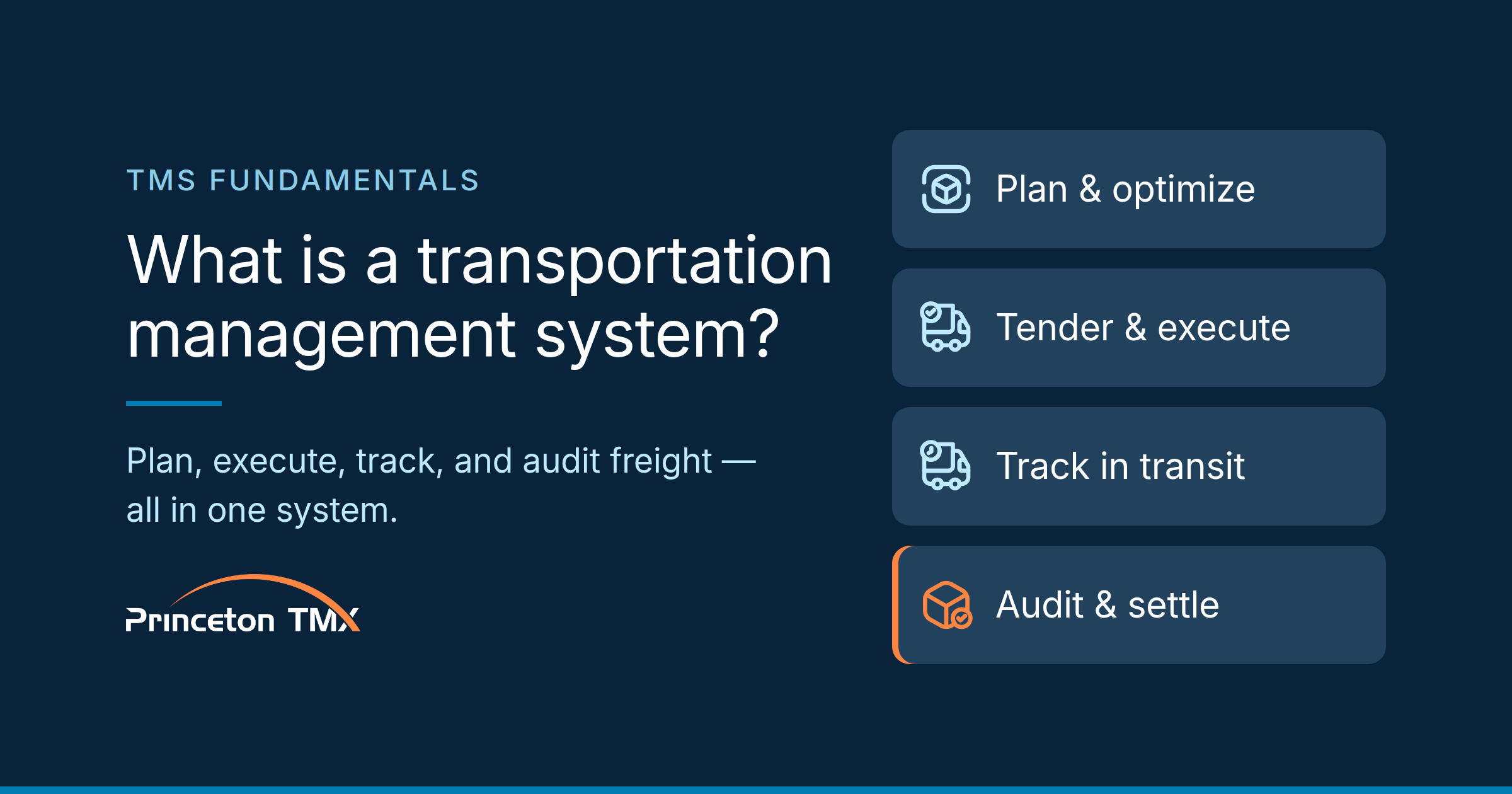
A transportation management system (TMS) is software that plans, executes, and manages the movement of freight, from the moment an order is ready to ship through delivery, invoicing, and performance reporting.
Also commonly referred to as transportation management software or a TMS system, these platforms are built by logistics technology vendors and used by shippers, carriers, and third-party logistics providers to run transportation operations.
For industrial shippers that are shipping steel, paper and packaging, food and beverage, and other manufacturers moving freight by rail, barge, private fleet, or truck, a TMS (quite literally) carries more weight than it does for a typical e-commerce or retail shipper.
Industrial freight is heavy, expensive, moves across many modes, and has very narrow tolerance for a missed rail car or a misrouted barge shipment. As a result, a TMS built to support industrial complexity looks much different than one built to track parcel deliveries.
What Does a Transportation Management System Do?
A TMS supports four core functional areas across the life of a shipment, starting with planning and optimization and ending with settlement and freight audits. Here's a breakdown of what happens at each stage.
Step 1: Planning and Optimization
Before a load moves, a TMS turns a stack of open orders into an efficient freight plan. At this stage, the system helps logistics managers identify and select the best mode and route for each shipment. The process includes building loads to maximize trailer or railcar utilization, and choosing which carrier gets the freight based on cost, service history, and contract terms.
That logic doesn't change based on what's moving. A steel coil scheduled to move by rail and a lumber shipment tendered to a private fleet go through the same planning logic, even though equipment, capacity constraints, and lead times are completely different.
Step 2: Execution and Tendering
Once a plan is set, the TMS offers the shipment to a trucking company or transport provider by tendering the load to the carrier. The system tracks whether each one is accepted or declined and automatically moves down a routing guide if a carrier passes on a load. Once loads are assigned, the TMS manages dock scheduling on the shipper's end and flags exceptions such as a declined tender or a missed pickup window, in real time.
Step 3: Visibility and Tracking
Whether you’ve got a barge shipment moving down the river or a refrigerated truckload crossing three states, once your freight ships, you need to know where it is. Some TMS systems give shippers live, real-time visibility into every shipment. Others only offer passive tracking, meaning you can check where a load is, but the system won't tell you until you go looking. More advanced TMS tools also offer active exception management, which flags problems — a delay, a detour, a missed appointment — before they turn into customer service issues.
Step 4: Settlement and Freight Audit
After freight moves, a TMS can perform a freight audit by matching the quoted rate against the invoice a carrier actually sends. The goal is to catch overcharges, duplicate billing, and incorrect accessorials before payment is issued. On a steel shipment moving by rail, this might mean proactively catching a mismatched fuel surcharge or an incorrect demurrage charge.
Audits also simplify bookkeeping by automatically feeding clean freight spend data into finance systems. The system eliminates the need for shippers to manually key in numbers from a stack of PDFs, reducing the risk of human error. On a steel shipment moving by rail, for example, this can mean catching a mismatched fuel surcharge or an incorrect demurrage charge before it’s paid, rather than disputing it afterward.
Core TMS Modules: What to Look for in a Platform
Functionality across these four areas varies widely by TMS system. For example, a TMS that's strong on planning can be shallow on settlement, or it may handle truckload well but treat freight audit as a bolt-on.
The module descriptions below show what full coverage looks like:
- Workflow Automation: Automate carrier selection and load tendering based on rate, capacity, and performance, so freight moves without having to work every load manually.
- Load Builder Optimization: Automatically groups orders into efficient loads based on destination, date, mode, and capacity constraints — reducing manual decision-making.
- Procurement Events: Provides structured bid and RFP tools for awarding lanes to carriers at negotiated rates, with spot-market access layered in for freight that falls outside contracted lanes.
- Exception Management: Centralizes every disruption — delays, missed tenders, failed pickups — into one workflow instead of scattering them across emails and phone calls.
- Dock Scheduling: Automates appointment requests, confirmations, and updates across facilities, provides self-service booking for carriers, and offers real-time visibility into dock and yard activity.
- Freight Audit: Automatically matches carrier invoices against contracts and routing guides, flagging rate errors, accessorial mismatches, and incorrect charges before invoices get paid.
- Carrier Performance: Provides scorecards that rate on-time pickup and delivery by carrier, lane, and time period, surfacing early warning signs — dwell spikes, delayed confirmations — before they become service failures.
- Lane and Spend Performance: Gives procurement, operations, and finance a shared, real-time view of where freight spend is going — and which lanes are trending the wrong way.
For industrial shippers specifically, multi-modal execution is the capability that matters most, and the one most horizontal TMS systems handle worst. Look for native support across truck, rail, barge, intermodal, and private fleet — not a transportation management software that handles truckload well and treats every other mode as a workaround. Solutions like Princeton TMX also offer AI-driven freight planning, shifting teams’ focus from reactive planning to forecasting freight needs before orders even come in.
TMS vs. ERP vs. WMS: What's the Difference?
This is the single most common point of confusion for shippers evaluating software, and it's worth being direct about:
- A TMS is not a smaller version of an enterprise resource planning (ERP) system, and an ERP's freight module is not a substitute for a TMS.
- A warehouse management system (WMS) is a third, related system that gets lumped into the same conversation but solves an entirely different problem.
This chart illustrates the differences.
To put it simply:
- An ERP tells you what needs to ship and manages the financial transaction behind it
- A TMS gets freight from point A to point B efficiently once the ERP generates the order
- A WMS tells you where inventory sits and how it moves inside a facility
For shippers with any real transportation complexity, the TMS layer needs to be purpose-built.
Trying to run transportation out of an ERP's freight add-on is a common cause of the hidden costs of inefficient transportation. Most bolt-on modules aren't designed for multi-modal execution at scale, and most shippers don't spot issues until a freight audit catches them.
Biggest Benefits of a Transportation Management System
The case for investing in a TMS comes down to five areas of measurable impact:
- Cost reduction: Optimized load building, carrier selection, and freight audit catch overpayment and inefficiency that's nearly invisible in a manual process. A cement and ready-mix concrete producer cut freight rates by 28% in its first year on Princeton TMX, alongside a sharp drop in overdue carrier payments once freight audit and mobile autopay were in place.
- Labor efficiency: Automating tendering, exception handling, and freight audit frees logistics teams from manual data entry so they can focus on carrier relationships and actual problem-solving. Roseburg Forest Products, a 10-facility multi-modal lumber and building products shipper, now auto-tenders 85% of freight with zero manual touch — cutting its daily manual exceptions queue from 80–100 loads down to roughly 5.
- Carrier compliance and performance. Scorecards and structured bid processes hold carriers accountable to negotiated rates and service levels, benefiting shippers.
- Sustainability reporting: Centralized shipment data makes emissions tracking and mode-shift analysis possible without a separate reporting layer. Princeton TMX makes it easier to meet increasingly complex regulatory expectations by surfacing audit-ready sustainability insights.
- Data ownership: A TMS becomes the system of record for transportation data, rather than that data living in individual planners' inboxes and spreadsheets.
Taken together, shippers moving freight across multiple modes see the largest gains, since a TMS that integrates all modes of transportation removes the coordination overhead of running separate tools per mode.
Savings from automation ROI can also compound quickly. Custom Glass Solutions, an LTL-heavy glass manufacturer, projected $350K in first-year savings after automating its freight operations and hit $750K in five months — a 20x return on their TMS investment.
Choose the Right TMS for Your Operation
Before you start comparing transportation management software, it’s important to answer a few key questions:
- What modes do you run? A truckload-only TMS will not serve you well if rail, barge, or private fleet make up any real share of your freight.
- What's your freight spend, and where is it concentrated? This determines whether you need enterprise-grade complexity or a lighter TMS system.
- Do you need a vendor, or a partner? Implementation and ongoing support quality vary enormously across vendors serving the same market segment.
- How ready is your data? Rate files, carrier contracts, and lane history all need to be in reasonable shape before implementation starts — this is consistently the biggest driver of how long a rollout takes, more than the software itself.
Another thing to consider: implementation timelines vary widely by platform type and integration scope, but for a mid-complexity industrial shipper, a purpose-built cloud TMS typically takes a few months from kickoff to go-live, with the largest variable being how many carriers and systems need to be connected — not the core software configuration.
Some form of TMS is now table stakes for any shipper managing freight at real volume. The differentiator is whether the TMS system was actually built for your kind of freight — and whether the vendor behind it functions as a long-term partner rather than a one-time sale. For shippers getting by on a fragmented mix of tools, moving to a self-managed TMS can mean the difference between owning your transportation data and renting visibility into it.
If you're ready to see what ownership looks like for your operation, request a demo or explore how Princeton TMX handles freight audit and workflow automation up close. Still weighing options? See our full breakdown of the best TMS software for shippers.
Transportation Management System Frequently Asked Questions
A transportation management system (TMS) is software that plans, executes, and manages freight movement — from carrier selection and load planning through delivery, invoicing, and reporting.
A TMS pulls in open orders, builds optimized loads, tenders them to carriers based on cost and contract terms, tracks shipments in transit, and reconciles freight invoices against the original quote once delivery is complete.
An ERP manages company-wide functions like financials and procurement. A TMS is purpose-built for transportation execution — planning, tendering, tracking, and freight audit — and generally does that job far more effectively than an ERP's freight module.
A WMS manages what happens inside a warehouse — picking, packing, inventory accuracy. A TMS manages what happens once freight leaves the dock. The two systems typically integrate rather than overlap.
It depends heavily on integration scope and data readiness. Still, carrier onboarding and system integrations — not the core software — are usually the biggest driver of timeline — more than any fixed number of weeks.
Any company that ships freight at meaningful volume — manufacturers, distributors, retailers, and food and beverage producers among them. Industrial shippers moving freight across multiple modes (rail, barge, truck, private fleet) see the most benefit from a TMS system purpose-built for that complexity, rather than a generic, truckload-first tool.