A decade ago, shippers had fewer than a dozen serious TMS vendors to choose from. Today, there are more than 150, and cutting through the noise is the hardest part of the buying process. The issue isn’t that 150 vendors are all fighting over the same customer — it’s that they're not.
The answer to "which TMS is right for you" depends entirely on how your freight moves. A steel manufacturer managing captive rail, private fleet, and intermodal moves across 14 facilities needs a very different solution than a mid-market distributor running LTL freight out of two warehouses.
This guide breaks down leading TMS platforms by analyzing who they're built to serve — industrial and multimodal shippers, large enterprise buyers, mid-market operations, and freight brokers — and gives you an honest read on the best fit for your operation.
What does a TMS actually do?
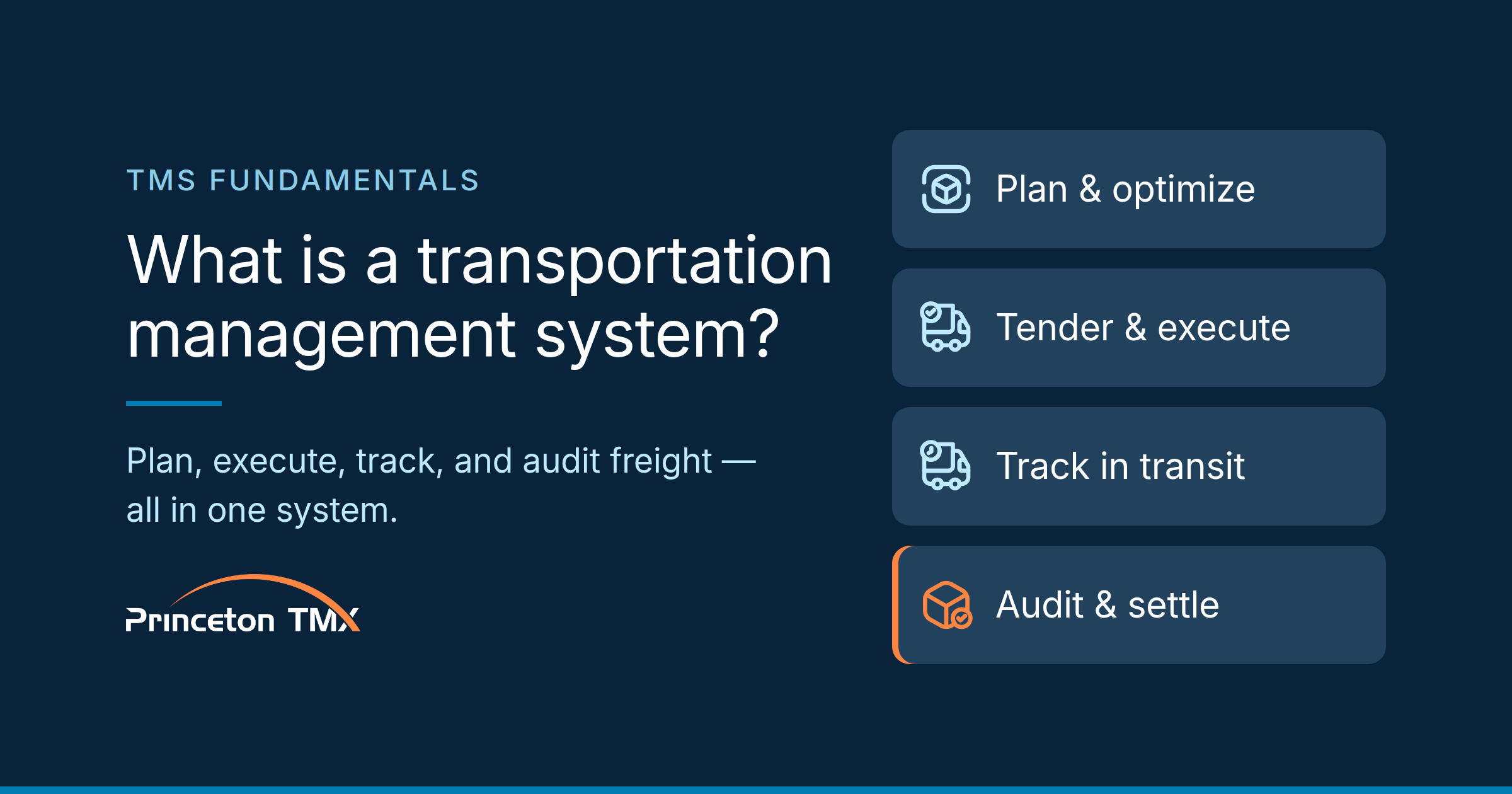
A TMS manages the full lifecycle of freight movement, from planning and carrier selection through execution, tracking, freight audit, and analytics. It replaces manual processes that support these workflows with automation and serves as a single source of truth for your transportation data.
Core TMS functions include load planning and optimization, carrier management and tendering, real-time shipment visibility, freight audits and payment, and performance reporting. More sophisticated platforms add multimodal execution, embedded AI, and deep ERP integration.
The gap between a basic TMS and a purpose-built platform for complex operations is significant, and making the wrong choice is expensive.
The best TMS software at a glance
The table below summarizes each platform covered in this article.
TMS platform evaluation criteria:
- Multimodal coverage (modes supported natively vs. via workarounds)
- AI and automation capabilities (embedded vs. surface-level)
- Integration depth (ERP, WMS, and carrier connectivity)
- Deployment timeline (how fast you can get up and running)
- Pricing model (subscription vs. enterprise license, transparency vs. quote-only)
We evaluated platforms across dimensions including multimodal coverage, AI and automation capabilities, integration depth, deployment timeline, and pricing model — though not every vendor publishes information on all five, and we've noted where that data wasn't available. Where applicable, we incorporated verified user reviews — including limitations flagged by users — from Gartner Peer Insights and G2.
The best TMS software for industrial and multimodal shippers
Industrial shippers — steel, paper and packaging, food and beverage, agriculture, chemicals — manage freight complexity that standard TMS platforms weren't built for. Rail, barge, private fleet, and intermodal moves don't fit neatly into a truckload-centric workflow. The platforms in this section were designed for that environment.
Princeton TMX
Best for: Industrial shippers managing multimodal freight across truck, rail, barge, fleet, and intermodal in North America.
Princeton TMX has been serving industrial shippers for more than 15 years, and unlike horizontal platforms retrofitted for industrial use, it's purpose-built. Every transportation mode lives in a single unified data model, not a patchwork of mode-specific tools — which matters when your inbound moves by rail, outbound by truck, and your private fleet sits in the middle.
Key features
- Workflow automation: Exception surfacing, business rule enforcement, automated tendering
- Unified multimodal execution: Standardized workflows across truck, rail, fleet, barge, and intermodal
- Manage your partner carriers and fleet all in one solution
- Network optimization: Built-in route, load, and capacity optimization
- Predictive analytics in TMS: Real-time visibility, disruption alerts, and an AI Agent for on-demand freight intelligence
- Detention & demurrage cost control: Automated tracking and exception alerts help shippers reduce detention charges before they erode margin
Multimodal coverage
Princeton TMX has full native support across truckload, LTL, rail, barge, private fleet, and intermodal. Rail automation is a first-class mode in the platform architecture, not an afterthought — a genuine differentiator against most competitors.
AI and automation
Princeton TMX embeds AI at the analytics layer rather than bolting it on as a feature. The platform uses machine learning and historical shipment data to surface exceptions, forecast disruptions, and automate repetitive workflows. Dex, the platform’s conversational AI Agent, allows logistics teams to query transportation data in natural language — particularly useful in environments where analysts are spread thin across multiple facilities. For a deeper look at how this works in practice, see AI-driven freight planning for industrial manufacturers.
Integrations
Princeton TMX connects to ERP, WMS, and carrier systems via API and EDI. Verified user reviews note successful integration with ERP systems such as Epicor LumberTrack, SAP, Oracle EBS, Oracle JDE, Sage, Infor, NetSuite, and many other ERP systems commonly used by shippers. The platform's freight audit capabilities connect transportation data directly to financial systems, eliminating manual reconciliation. The platform is also consistently recognized for its intuitive design and ease of use.
Deployment and implementation
Most implementations, supported by a structured milestone framework, take 90–120 days. The SaaS+ model means Princeton TMX stays engaged post-go-live with ongoing customer success, QBRs, and regular product updates.
Pricing
Pricing is tiered by shipment volume, feature access, and integration scope.
Pros:
- Purpose-built for industrial multimodal complexity
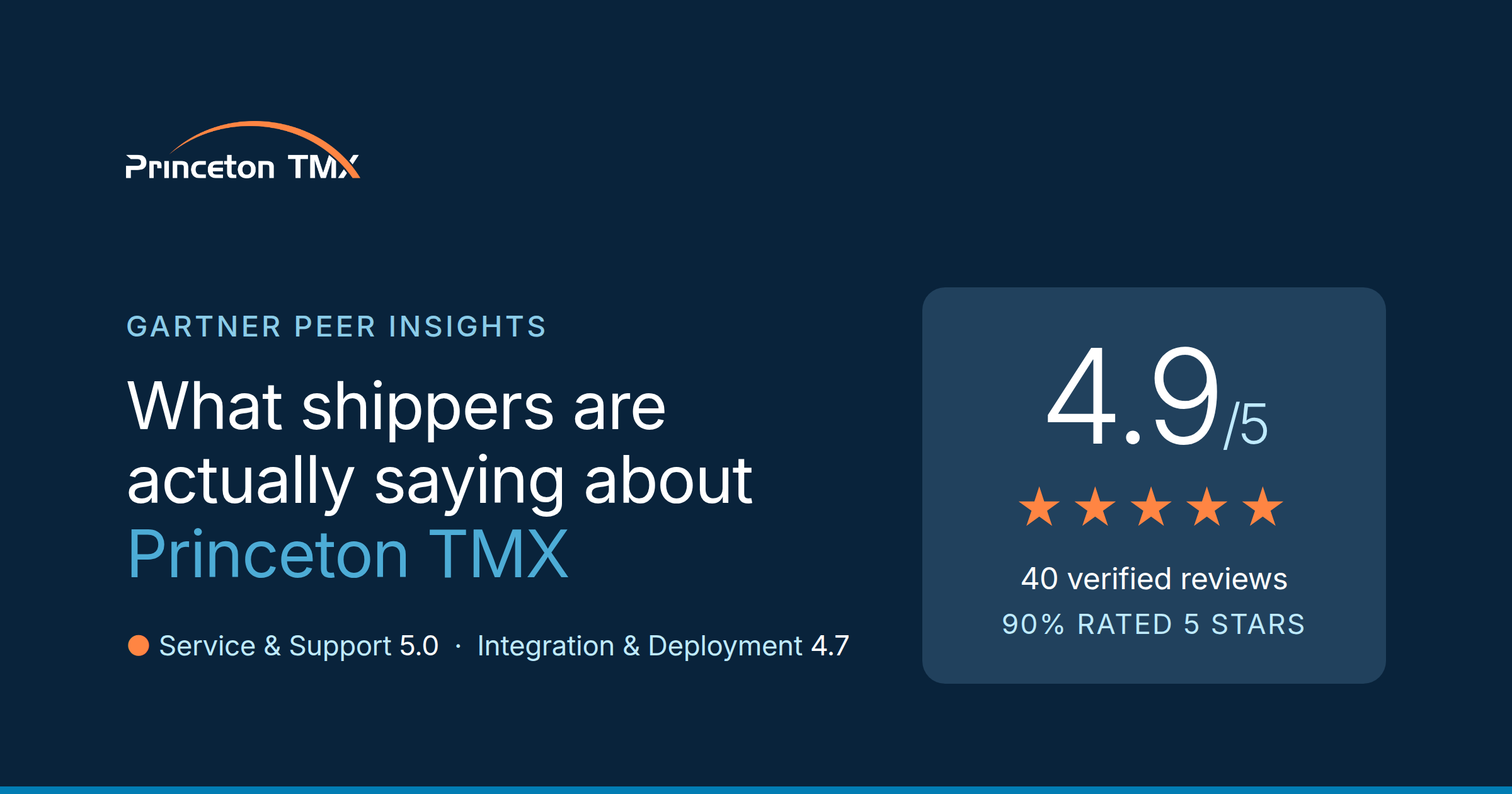
- Rated 4.9/5 on Gartner Peer Insights (41 reviews); 99% customer retention
- Nucleus Research mid-market Leader, alongside Oracle and Manhattan Associates
Cons:
- North America only
- No ocean support today; phased support is on the roadmap, beginning with ocean tracking.
- Not a strong fit for parcel-dominant shippers in need of last-mile operational support
IntelliTrans
Best for: Bulk and break-bulk shippers with heavy rail exposure — agriculture, metals, chemicals, forest products, oil and gas.
IntelliTrans, a Roper Technologies company, is a 30-year-old platform built specifically for bulk commodity shippers. Its rail TMS covers fleet tracking, lease management, maintenance scheduling, demurrage audit, and railcar utilization in ways that general-purpose platforms don't. Rail, truck, barge, and ocean are all supported, with optional managed services for shippers who want operational expertise alongside software.
IntelliTrans holds an 84% 'great' User Satisfaction Rating on SelectHub, based on an aggregate of 50 reviews across four software review sites, with strong marks for integration and multimodal data unification. Some users note that comprehensive reporting requires configuration time to unlock.
Pros:
- Deepest rail management capability in the market for bulk commodity shippers
- Managed services option for shippers who want domain expertise, not just software
- Includes EPA SmartWay-certified carbon emissions reporting
Cons:
- Less suited to shippers whose primary mode is truckload with minimal rail exposure
- Reporting requires upfront configuration investment to maximize value
- Some evaluators cite slower feature releases
Infios (formerly MercuryGate)
Best for: Shippers and 3PLs that want domestic and international TMS integrated with WMS and order management in a single platform.
MercuryGate was acquired by Körber Supply Chain Software in late 2024 and rebranded as Infios in March 2025. The TMS capability builds on MercuryGate's multimodal freight planning, carrier management, and rate management — but the platform now integrates TMS with WMS and order management into a single supply chain execution suite. For buyers evaluating Infios purely as a TMS, the expanded suite is either a feature or a distraction.
Pros:
- Full multimodal coverage including domestic and international modes
- TMS + WMS + OMS in one platform for buyers looking to consolidate vendors
- Strong claims management and bid automation
Cons:
- Lower customer retention rate than peers, per Gartner's 2026 analysis
- User experience improvements have lagged competitors
- The integration between legacy Körber WMS and MercuryGate TMS is still maturing
The best TMS software for large enterprise shippers
Enterprise TMS buyers typically have global freight networks, complex ERP environments, and the budget to absorb long implementations. Platforms in this section are the right fit when you need the full weight of a Tier 1 system and can invest 12–24 months in configuration and deployment to get there. For context on how these costs accumulate over time, see our breakdown of the hidden costs of inefficient transportation management.
Oracle Transportation Management (OTM)
Best for: Fortune 500 companies with global, multi-region freight complexity and existing Oracle ERP infrastructure.
Oracle OTM is the category-defining enterprise TMS — built for organizations moving thousands of shipments daily across continents, covering all modes and geographies with deep Oracle ERP integration. Gartner named Oracle a Leader in the 2026 TMS Magic Quadrant (MQ).
Pros:
- Broadest global mode and geography coverage in the market
- Unmatched configurability for complex business rules
- Native Oracle ERP integration
Cons:
- Implementations typically run 6–24 months
- Total cost of ownership starts at $200K+ annually
- Industry-agnostic architecture means vertical-specific requirements need systems integrator (SI) verification
SAP Transportation Management
Best for: Organizations already running SAP ERP that need native transportation management without a multi-vendor integration project.
SAP TM is the logical choice for SAP-native environments — native ERP integration eliminates a class of complexity that third-party TMS bridges can't match. Gartner named SAP a Leader in the 2026 MQ.
Pros:
- Seamless integration for SAP-native operations
- Strong global mode coverage
- Eliminates multi-vendor integration overhead
Cons:
- High subscription costs, per Gartner peer reviewers
- Longer-than-average implementation timelines
- Poor value proposition if you're not already in the SAP ecosystem
Manhattan Associates TMS
Best for: Large enterprise shippers in retail, grocery, and manufacturing that want transportation and warehouse management on a single cloud-native platform.
Manhattan Active TMS runs on a microservices architecture — with continuous updates and no disruptive version releases. Gartner named it a Leader in the 2026 MQ with one of the strongest retention rates in the peer set. Embedded AI Agents launched across all solutions in early 2026.
Pros:
- Cloud-native architecture with continuous updates
- Among the highest customer retention rates in the enterprise tier
- Strong AI Agents embedded across the platform
Cons:
- Primary focus is retail, grocery, and life sciences — other verticals should pressure-test industry support depth
- Enterprise pricing and implementation timelines apply
e2open
Best for: Large global enterprises managing multi-tier supply chains that need transportation integrated with broader supply chain network visibility.
Acquired by WiseTech Global for $2.1B in 2025, e2open sits at the intersection of TMS and global supply chain orchestration. Named a Leader in Gartner’s 2026 MQ, this platform can be a strong fit when supply chain network complexity is the primary problem, rather than transportation execution depth.
Pros:
- Broad global supply chain visibility beyond pure TMS
- Strong multi-tier network coordination capabilities
- Gartner Leader placement
Cons:
- Innovation pace lags peers, per Gartner cautions
- Some customers have flagged limited flexibility in contract negotiations
- Not the right fit if transportation execution depth is the primary requirement
The best TMS software for mid-market shippers
Mid-market shippers need strong core TMS functionality without enterprise-level cost or 18-month implementation timelines. The platforms below are built for growing companies with real freight complexity.
Shipwell
Best for: Mid-market shippers and 3PLs that want AI-integrated TMS with strong visibility, fast deployment, and modern UX — without brokerage complexity in the workflow.
Shipwell sold its brokerage arm to CloudTrucks in early 2024 and has since focused entirely on its SaaS TMS platform. The company reported 30%+ year-over-year revenue growth in 2025 and a 55% increase in monthly shipments processed compared to 2024 in its year-end release. In January 2026, they launched configurable AI Workers — which autonomously handle tracking, carrier communications, and exception management.
Pros:
- Modern, user-friendly interface with strong AI automation layer
- Fast deployment; strong fit for truck-dominant mid-market operations
- Solid innovation execution per Gartner (delivered against 2024 and 2025 roadmaps)
Cons:
- Not profitable in 2025; limited implementation partner ecosystem
- Less differentiated for shippers with significant rail, barge, or private fleet complexity
- Global expansion lags competitors
FreightPOP
Best for: Mid-market shippers who need multi-mode rate shopping, strong ERP integration, and fast cloud-native deployment.
FreightPOP connects to 1,500+ carriers across parcel, LTL, FTL, ocean, rail, and international air, with out-of-the-box ERP integrations to NetSuite, SAP, Microsoft Dynamics, and Acumatica. User satisfaction sits at 95%, and SelectHub's analysis gives the platform a perfect score for invoicing. Strong fit for shippers with high LTL volume and multi-carrier rate shopping needs. Less differentiated for industrial shippers managing rail, barge, or private fleet complexity.
Pros:
- Connects to 1,500+ carriers across parcel, LTL, FTL, ocean, rail, and air
- Strong out-of-the-box ERP integrations
- Fast cloud deployment makes it attractive for mid-market shippers
Cons:
- Not purpose-built for complex multimodal industrial shipping
- Reporting and analytics are less robust than leading enterprise TMS platforms
- Limited optimization capabilities for complex industrial transportation networks
AscendTMS
Best for: Small shippers, 3PLs, carriers, and brokers that want a genuinely free entry point with the option to scale into a paid tier. Operates mainly in North America.
AscendTMS, built by InMotion Global, is a cloud-based transportation management system designed for small and midsize shippers, 3PLs, carriers, fleets, and freight brokers. The platform offers two service tiers: 1) a free plan covering basic TMS functions for a limited number of users, and 2) a premium tier that unlocks full enterprise functionality.
Pros:
- Transparent, published pricing model; free-to-paid path is clear
- Widely-adopted platform with a large active freight user base in North America
- Self-service onboarding — teams can start using the free tier without a sales cycle
Cons:
- Free tier is capped on users and capabilities (you'll hit the paywall quickly if you scale)
- Skews toward small shippers/carriers/brokers
- Less shipper-specific workflow capabilities
The best TMS software for freight brokers and 3PLs
Broker and 3PL TMS workflows are fundamentally different from shipper-side needs — brokers manage freight on behalf of many customers across a carrier network, while shippers manage their own end-to-end transportation operation. If you're a shipper evaluating the market, this section provides useful context — but these platforms weren't built for your freight operation.
Uber Freight TMS
Best for: Freight brokers and 3PLs that want TMS functionality combined with carrier network access in a single vendor relationship.
Uber Freight's TMS runs on the Transplace foundation — an established enterprise TMS platform acquired for $2.25 billion in 2021. The platform combines freight management software with access to Uber Freight's carrier network and managed transportation services. Gartner named Uber Freight a Challenger in the 2026 MQ, noting strong marks for customer retention and market understanding.
Pros:
- Enterprise-grade TMS depth
- Strong real-time visibility and load planning
- Intuitive interface; fast user onboarding
Cons:
- Limited report customization for niche requirements
- Customer support responsiveness is a known friction point
- North America-focused; limited global expansion
Turvo TMS
Best for: Freight brokers and 3PL providers that want a collaborative, multi-party TMS rather than a broker-only dispatch tool.
Turvo — the technology behind RyderShare — is built around shared visibility. Unlike a traditional broker TMS that confines brokers to their own dispatch queue, Turvo puts brokers, 3PLs, shippers, and carriers into one collaborative workspace. The platform provides real-time margin reporting and includes an integration hub that covers load boards, capacity management, accounting tools, and third-party visibility and tracking providers.
Pros:
- Built for multi-party collaboration (shared visibility for shippers, carriers, and brokers)
- Strong integration ecosystem
- Real-time P&L visibility by customer, rep, and carrier
Cons:
- Implementation timelines can run long
- Customer support responsiveness flagged across multiple review sources
- Better fit for high-touch freight programs than pure-play dispatch-focused brokerages
How to choose the right TMS for your operation
Making the right TMS decision starts with asking four operational questions:
- What modes do you actually run? Be specific about mode split — not what you run occasionally, but what drives your transportation spend. Many platforms built for truck-dominant operations have genuine gaps in rail, barge, and fleet management.
- What's your annual freight spend? Enterprise platforms with 12–18 month implementations and $500K+ annual costs make sense for organizations spending $100M+ on transportation. Mid-market platforms are better suited to $5M–$50M in freight spend. The ROI math has to make sense.
Curious to see how fast Princeton TMX pays for itself? Check out our ROI calculator. - How long can you absorb an implementation? If your current system is failing and you need to be live in 90 days, Oracle OTM and Manhattan Associates TMS are not realistic options. Know your timeline before you evaluate platforms that can't meet it.
- Are you looking for software or a technology partner? Some vendors sell software and expect customers to own the operational expertise. Others — Princeton TMX's SaaS+ model is the clearest example — stay engaged as operational partners.
Why industrial shippers choose Princeton TMX
Industrial shipping customers who choose Princeton TMX quickly benefit from our:
- Purpose-built multimodal execution: While most platforms bolt rail, barge, and fleet support onto a truckload-first foundation, Princeton TMX was engineered around all modes from day one. That means you’re managing carriers and private fleets in a single unified system.
- Implementation speed: Our 90–120 day implementation model is a real differentiator in a space where 12–18-month deployments are the enterprise norm.
- Ongoing partnership: Published customer results include a 25% reduction in freight spend and a 20x ROI on LTL automation.
Thanks to a built-in AI analytics layer, predictive disruption capabilities grow more valuable as the system accumulates shipment history, compounding value over time.
Ready to see how Princeton TMX maps to your operation? Request a demo.
Best TMS Software FAQs
The answer depends on your operation type, freight modes, volume, and budget — which means the right question isn't which TMS is best overall; it's which TMS is best for your specific operation. Industrial shippers managing multimodal complexity in North America consistently evaluate Princeton TMX and IntelliTrans. Enterprise buyers with global networks look at Oracle OTM, SAP TM, Manhattan Associates, and e2open. Mid-market shippers typically shortlist Shipwell, FreightPOP, and Ascend. Freight brokers evaluate purpose-built options like Uber Freight TMS and Turvo.
A TMS manages the planning, execution, and optimization of freight movement. Core functions include load planning and optimization; carrier selection and tendering; real-time shipment visibility and tracking; freight audit and invoice reconciliation; and transportation analytics. Modern platforms add AI-driven exception management, predictive analytics, and ERP integration. The practical result is that manual processes — spreadsheets, phone queues, email chains — get replaced with automated workflows that surface exceptions faster, reduce freight costs, and give logistics teams real-time visibility across their network.
Your ERP and TMS are complementary systems, not substitutes for one another. An ERP manages core business functions: finance, accounting, inventory, HR, procurement. A TMS manages transportation execution: carrier selection, load planning, shipment execution, freight audit, and transportation analytics. The integration between your TMS and ERP is critical. When transportation data doesn't flow cleanly to your financial systems, freight bill reconciliation becomes manual work, and your transportation cost data is always stale.
Managing private fleet and third-party carrier operations in a single TMS is a real complexity problem because most platforms are built to manage one or the other. Princeton TMX is an exception because it natively handles third-party carriers and private fleet management — making it a consistent favorite for industrial shippers managing both. IntelliTrans also supports fleet and carrier management for bulk commodity shippers. For larger enterprises with significantly longer implementation timelines, Oracle OTM and SAP TM support fleet management alongside third-party carrier operations.
Ease of use is one of the most important TMS selection criteria and one of the most underweighted in procurement processes. Princeton TMX reviews on Gartner Peer Insights consistently note that new users are able to understand and become productive inside the platform very quickly — sometimes in a day or less. Shipwell also has strong usability marks. Oracle OTM and SAP TM are powerful but have documented learning curves. Ask every vendor you evaluate how long it typically takes a new user to complete common tasks unassisted.
TMS implementation timelines can range from weeks to years. Princeton TMX targets 90–120 days for most implementations. FreightPOP and Ascend can go live in weeks. Enterprise platforms (Oracle OTM, SAP TM, Manhattan Associates) typically run 6–24 months . Ask vendors not for their best-case timeline but for the range across their last ten implementations, find out how they track progress, and ask how they handle scope changes mid-process.