If you run freight for an industrial manufacturer, you've probably had this conversation: your team is stretched, your freight spend keeps climbing, and someone — a consultant, a peer at another company, or a vendor sales rep — told you the fix is to hand the whole operation to a managed transportation provider and let them handle it. While not wrong, that advice is incomplete.
There are two real paths: investing in managed transportation services, or investing in a transportation management system (TMS). Both aim to solve the same problem — inefficient, disconnected freight operations — but they get there differently. This article lays out both models honestly, explaining what each one does, where the real trade-offs are, and how to figure out which one fits your operation based on your team size, volume, and how much control you want to keep.
What is Managed Transportation?
Managed transportation — often sold as managed transportation services — transfers responsibility for your freight operations to a third-party provider, typically a 3PL. The vendor takes over carrier procurement and contracting, load tendering, shipment tracking, freight audit and payment, and reporting.
You still own the freight, but the provider runs the process, making day-to-day carrier and routing decisions using their own systems and data. Your internal team steps back from the tactical work and shifts to managing the relationship with the provider instead.
What Does TMS Stand for in Logistics?
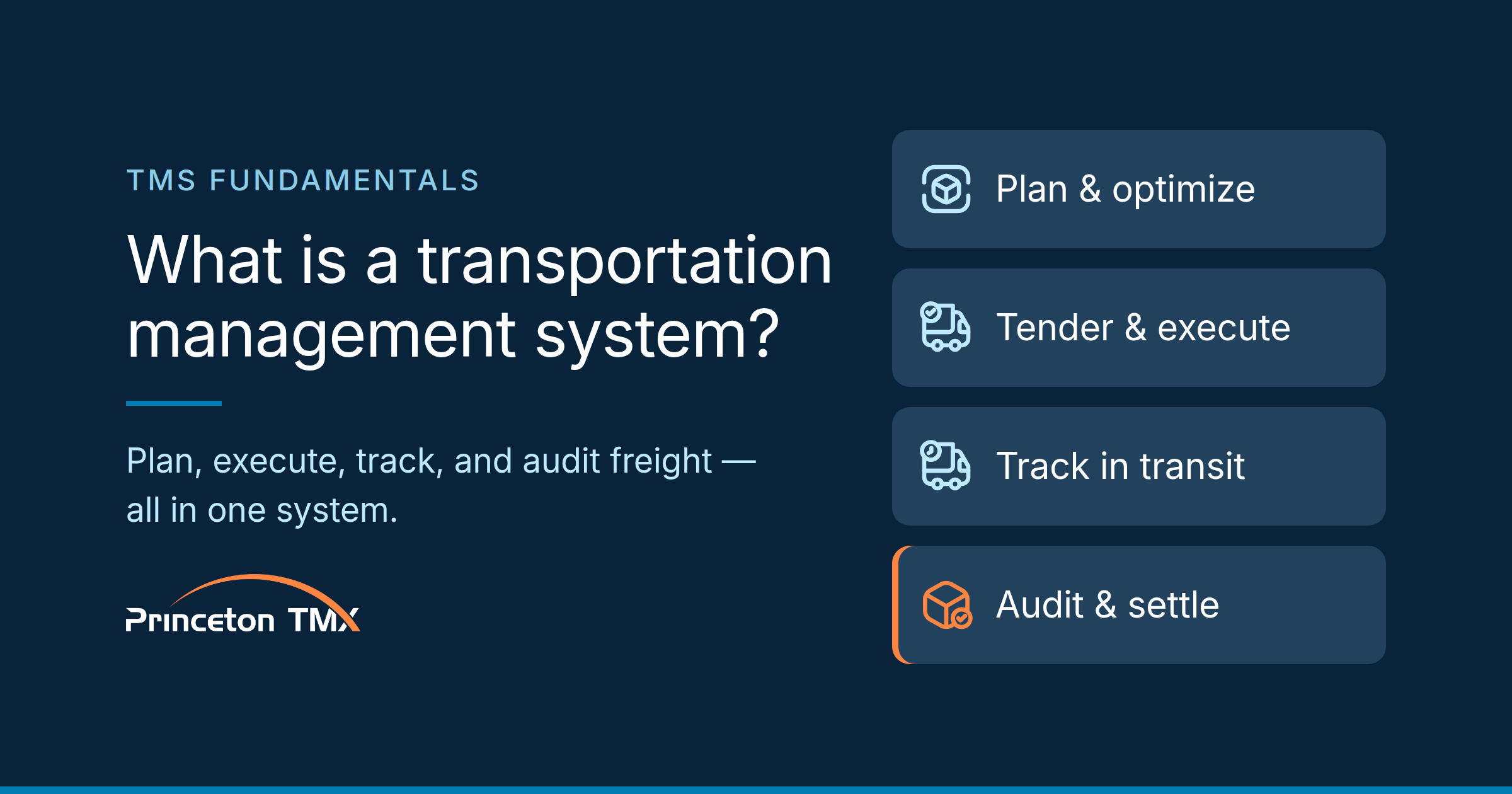
TMS stands for transportation management system, software logistics teams use to plan, execute, and manage freight.
A TMS automates functions like load planning, carrier selection, tendering, tracking, and freight audits; your team makes operational decisions.
Managed Transportation vs. TMS: The Core Difference
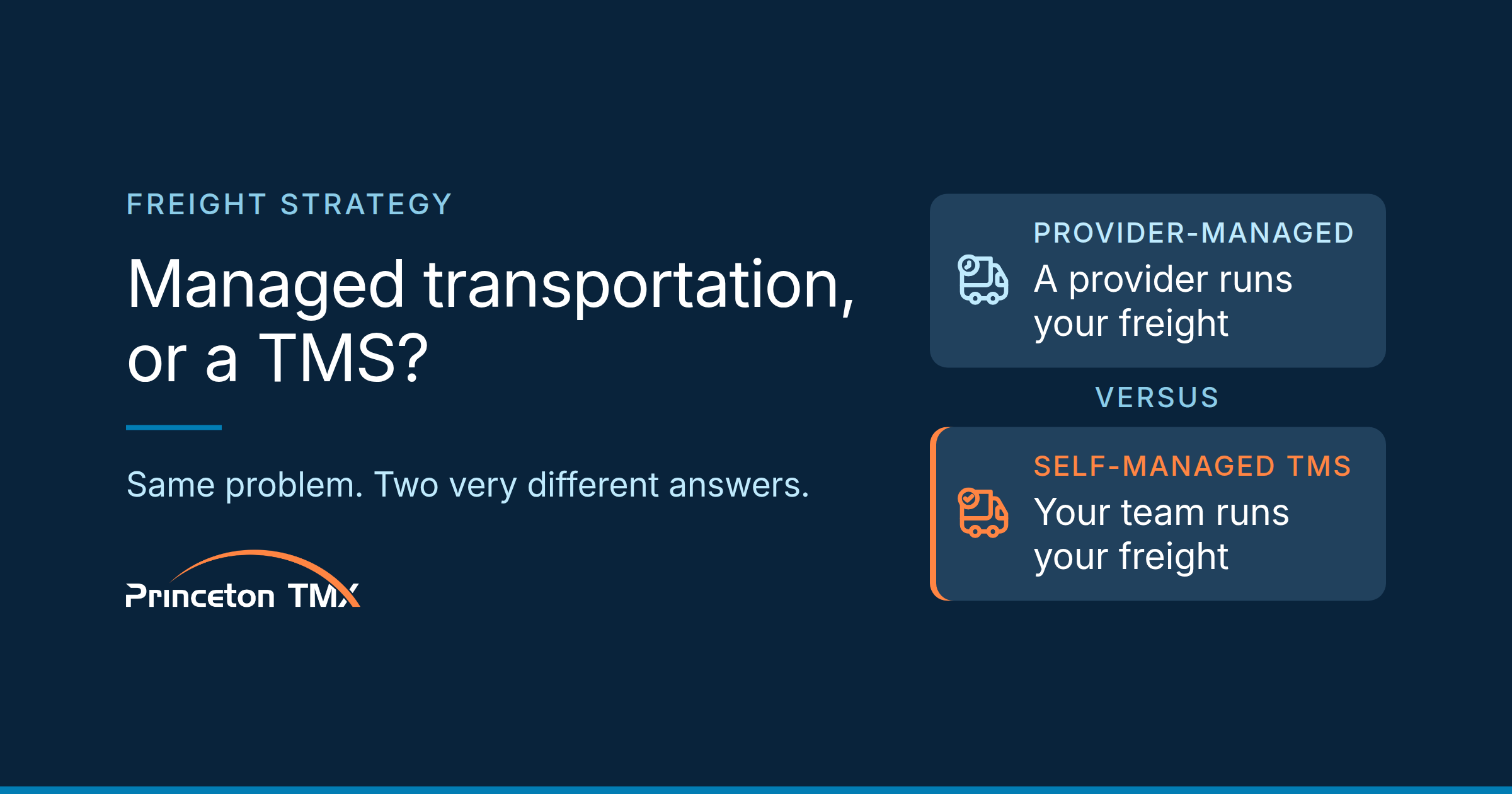
The core difference isn't features or price. It's who does the work. Managed transportation takes the operational burden of freight management off your plate; a TMS gives your in-house team software with built-in workflows and automation to run that operation efficiently. Every other trade-off — control, cost, staffing, scalability — flows from that one decision. Here are the key things to weigh as you decide which model fits your operation.
Control and Data Ownership
With a self-managed TMS, your team owns data on your lane history, carrier performance, rate trends, and exception patterns. That data compounds over time, turning into a strategic asset that helps you optimize negotiations, conduct network redesigns, and handle peak season plans.
With managed transportation, that data lives on the vendor’s platform, not yours. You typically get reporting and dashboards, but the decision-making logic doesn’t live in your system. For industrial shippers with long-term carrier relationships and complex lane networks, that's worth weighing carefully. Limited visibility can be a major contributor to the hidden costs of inefficient freight management.
Whether or not you have disparate transportation management systems is also relevant to the decision. Shippers that outsource parts of their network and manage other parts in-house end up with fragmented data, which means no single system can tell the end-to-end story.
Cost and Total Cost of Ownership
Managed transportation converts a technology investment into a service fee — an operating expense that's easy to budget for and requires no upfront commitment. That's a real advantage, especially for a leaner team. But at sufficient freight volume, the math shifts.
Provider fees typically scale with shipment volume or spend, so the more you ship, the more the outsourced model costs, indefinitely. In contrast, a self-managed TMS has a heavier upfront lift, but the cost per load tends to flatten out and drop as volume grows, because you're paying for software, not a per-transaction service margin.
Implementation and Time to Value
Managed transportation transitions are typically the fastest path to relief — most providers can be operational in 60 to 90 days, since you're largely plugging into their existing infrastructure and team
Traditional TMS implementations can take 12 to 18 months, which is one reason some manufacturers turn to managed transportation instead. Princeton TMX is the exception: our average implementation runs 90 to 120 days, narrowing that gap considerably.
Staffing Requirements
Managed transportation reduces the internal headcount needed to run freight day-to-day since the provider's team absorbs that tactical load. For a company managing 3-5 dedicated logistics staff, that's a real and meaningful reduction in staffing cost.
A self-managed TMS still requires a team, but it changes what that team spends its time doing. Instead of manually building loads, chasing carriers, and reconciling invoices, your staff’s attention shifts to higher-value work: exception management, carrier strategy, network analysis. For mid-market industrial shippers with strong TMS adoption across the team, the same-sized team can handle significantly more volume, reducing the need to increase headcount.
Scalability and Long-Term Fit
Managed transportation tends to work well for shippers that want to stay lean and either don’t have or don’t want to build internal logistics expertise. However, it can start to feel limiting if freight volume grows, priorities shift toward tighter carrier relationships, or leadership decides data ownership is important.
A self-managed TMS scales with your shipment volume and complexity from the start, so there's no outsourcing relationship to unwind later if your priorities change.
What About the Hybrid Model?
A middle ground exists, and it’s worth a brief mention. Managed TMS, sometimes called a hybrid model, exists when a 3PL operates TMS software on your behalf rather than running freight through their own proprietary process. It gives you access to modern technology without the internal lift of operating it yourself.
The trade-off is familiar: you get access to technology without full operational control. For some shippers, this works as a transitional step — providing a way to modernize before bringing the function fully in-house — but it's rarely the right long-term option for shippers who want to own their freight strategy.
Why Industrial Shippers Choose a Self-Managed TMS
For heavy industrial shippers — steel, paper and packaging, food and beverage, rail-dependent manufacturers — the case for a self-managed TMS usually comes down to three things: the freight is complex enough to reward in-house expertise, the volume is high enough that outsourcing costs compound, and the carrier and lane relationships are strategic enough that companies don't want to hand them to a third party.
Princeton TMX is built specifically for industrial shippers. Our SaaS+ model pairs the software with hands-on implementation and account support, so your team gets the control of a self-managed platform without being left to figure it out alone.
Implementation runs 90 to 120 days on average; the platform offers the many benefits of a multimodal TMS in a single system. Truckload, LTL, rail, and intermodal live in the same system (most managed transportation providers specialize in a single mode), and built-in predictive analytics in transportation management give your team forward-looking visibility. The most telling data point, though, is that shippers who choose Princeton stick around: Our retention rate sits around 99%.
Self-Managed TMS: Pros and Cons
A self-managed TMS isn't automatically the right call for every shipper. Here's an honest look at both sides:
Pros:
- Full ownership of freight data, carrier relationships, and lane history
- Cost per load flattens and drops as volume grows, rather than scaling indefinitely with a provider fee
- No dependency on a third party's staffing, systems, or priorities
- Optionality: you're never locked into unwinding an outsourcing relationship to regain control
Cons:
- Requires an internal team to operate the system
- Upfront implementation lift
- Less attractive for shippers who want to stay lean and don't need deep control over freight data
For industrial shippers running meaningful volume with a logistics team already in place, the pros side tends to outweigh the trade-offs. For smaller or leaner operations, managed transportation may still be the better near-term fit. But if you want to control your configuration, carrier relationships, and data, a self-managed TMS is the solution you’re looking for. To see what that looks like for your operation, request a Princeton TMX demo.
Still in the research phase? Start with our ROI calculator.
Managed Transportation Frequently Asked Questions
Managed transportation, also marketed as managed transportation services, is an outsourced freight model where a third-party provider handles carrier procurement, load tendering, tracking, and freight audit on your behalf, using their own systems and team.
TMS platforms range from broad enterprise systems built for large multimodal shippers to specialized tools focused on a single mode, like truckload-only or parcel-only software. Princeton TMX is built specifically for industrial shippers who need multimodal execution — truckload, LTL, rail, and intermodal — in one system.
Freight forwarding typically focuses on arranging the movement of specific shipments, often across international or multimodal legs. Managed transportation is broader: it's an ongoing, outsourced operational partnership covering your entire freight program, not just individual shipments.
TMS stands for transportation management system — software that a shipper's own team uses to plan, execute, and manage freight operations in-house.
Not exactly. A 3PL (third-party logistics provider) is the type of company that typically offers managed transportation as one of its services. Managed transportation is the service model; 3PL is the category of provider that delivers it.
It varies by freight profile, but generally, as shipment volume and spend grow, managed transportation fees — which typically scale with volume — start to outweigh the flatter, per-load cost curve of a self-managed platform. Shippers moving meaningful industrial freight volume tend to hit that crossover point sooner than they expect.
Yes — some shippers run a hybrid model, using managed TMS for part of their network while retaining direct control over strategic lanes or carrier relationships elsewhere. It's often a transitional approach rather than a permanent structure.