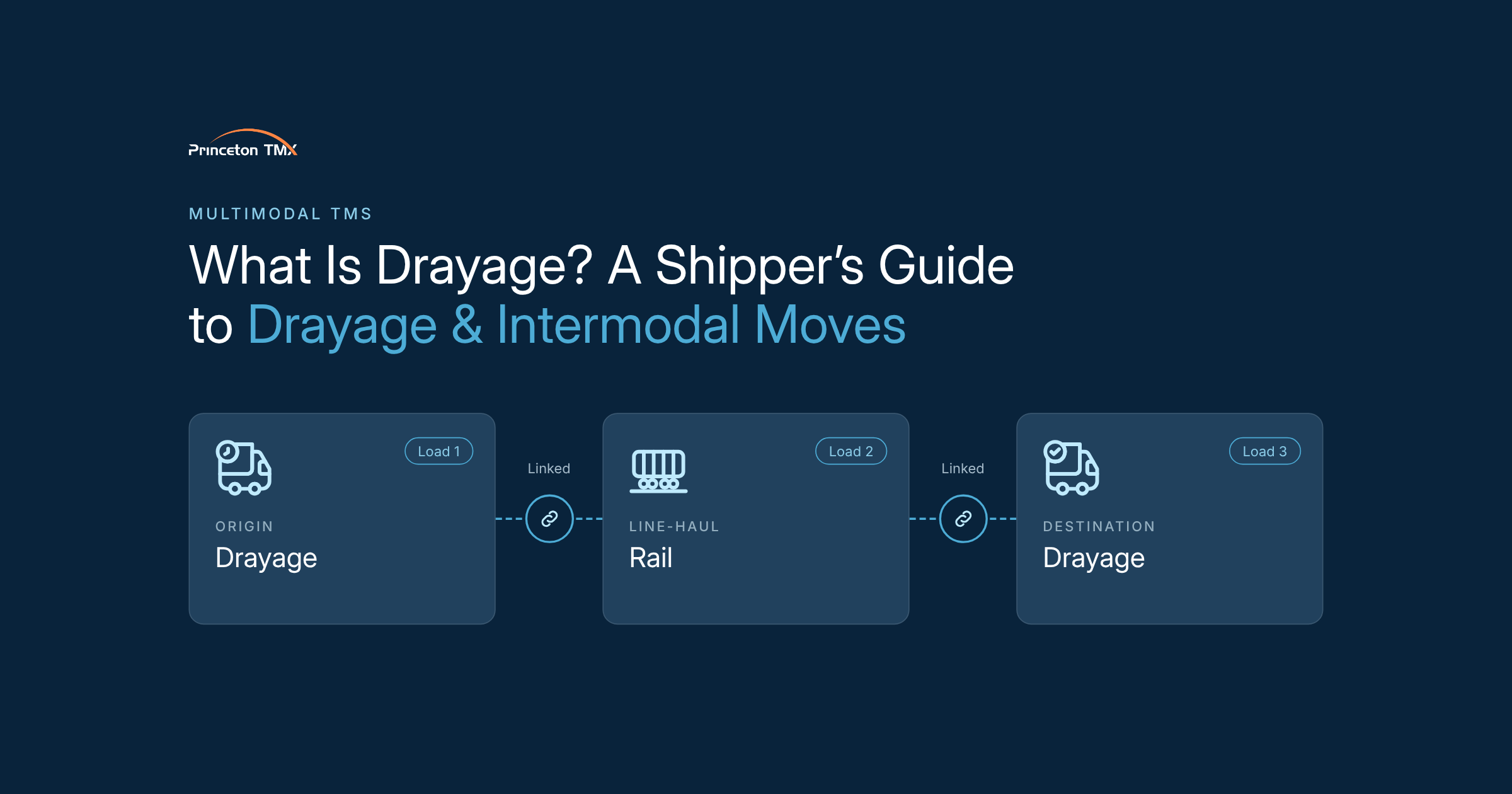
You’ve seen them everywhere: long freight trains and endless trucks hauling the exact same colorful boxes on the highway. This isn’t a coincidence; it’s a highly coordinated system called intermodal shipping. Think of it as a relay race for your products, where the cargo is the baton, passed between different modes of transport to get from its origin to you.
The real hero of this process is the standardized container itself. It acts like a universal Lego brick for global trade. Because every container has identical dimensions and locking mechanisms, it can be lifted by a crane from a truck’s chassis and placed directly onto a train car without ever being opened. This is one of the key benefits of intermodal containers: the goods inside—whether sneakers or breakfast cereal—remain untouched and secure throughout the journey.
Intermodal shipping works in practice as a simple, three-step dance. First, a truck handles the short initial trip from a warehouse to a rail terminal. This first and last mile trucking is called drayage, a critical part of how intermodal shipping actually works. Next, the container is moved onto a train for the long-haul portion, which can be hundreds or thousands of miles. Finally, upon arriving at a terminal near its destination, the container is lifted back onto another truck for final delivery to a store or distribution center.
Why Switch to Rail? The Two Biggest Wins for Shippers
For any business watching its bottom line, the decision to switch from truck-only to intermodal shipping boils down to a powerful combination of savings and strategy. While it’s not a perfect fit for every shipment, the advantages for long-distance freight are too significant to ignore. The primary driver is a dramatic reduction in cost-per-mile. Think of it this way: the initial truck trips to and from the rail yard have fixed costs, but once a container is on a train, it can travel hundreds of miles for a fraction of the cost of a truck. As a rule of thumb, shipments traveling over 750 miles are prime candidates for big savings.
Beyond the immediate financial benefits, converting freight to rail offers a major environmental advantage. A single freight train can move the equivalent of several hundred trucks, and it does so with surprising efficiency. On average, rail is three to four times more fuel-efficient than trucking, which means a much smaller carbon footprint for every item shipped. For companies focused on sustainability, this makes intermodal a key part of their strategy to be more eco-friendly.
In short, the move to intermodal gives businesses two compelling reasons to change how they ship:
- Significant Cost Savings: Drastically lowers transportation costs on long-haul routes.
- Reduced Carbon Footprint: A more sustainable choice that reduces fuel consumption and emissions.
Of course, these benefits don’t come without a trade-off. The biggest question a shipper must ask is: can this shipment afford to take a little more time on its journey?
What's the Catch? Why Trucks Are Still King for Speed
If intermodal is cheaper and greener, why isn't everything shipped that way? The answer comes down to one simple factor: time. While a truck driver can hit the highway and drive directly to the destination, an intermodal shipment involves a few extra steps. The container has to be dropped off at a rail yard, loaded onto the train, and then picked up by another truck at the other end. These handoffs, while efficient, add to the total journey. Typically, the average intermodal transit time is about a day or two longer than sending a truck straight through.
For some products, that extra day is a dealbreaker. Think of a truckload of fresh strawberries heading to a grocery store or a batch of seasonal decorations that absolutely must arrive before a holiday. In these time-sensitive cases, the speed and directness of a dedicated truck are worth the higher cost. Businesses shipping perishable goods or items needed for a specific event often stick with the highway to avoid the risk of a costly delay. This is the central challenge of intermodal shipping: balancing savings against the clock.
However, for a vast amount of freight, that extra day or two doesn't matter nearly as much as the cost savings. Items with a long shelf-life—like canned goods, bottled beverages, paper towels, or furniture—are perfect candidates. For these shipments, the decision becomes a simple calculation. It raises the key question: at what point do the cost and environmental benefits of rail outweigh the need for speed?
The Decision Point: What Defines a Good Intermodal Lane?
So, how do companies know when to make the leap from road to rail? The decision hinges on a few key criteria, and the first is surprisingly straightforward: distance. Intermodal shipping generally hits its sweet spot on journeys over 750 miles. For a cross-country haul, like moving goods from a port in Los Angeles to a warehouse in Chicago, the long stretch of railway provides massive fuel and cost savings that more than make up for the short truck trips at either end.
Beyond just the mileage, the weight of the freight plays a huge role. Trains are incredibly efficient at moving heavy, dense products. Think about a full truckload of bottled beverages, paper rolls, or building materials. Moving that much weight on the highway is tough on a truck’s fuel economy, but a train can pull hundreds of such containers with relative ease. This means heavier shipments often see the most significant cost reductions when they convert to intermodal.
Finally, the nature of the product itself is a critical factor. The ideal candidate for an intermodal journey is something durable and not on a razor-thin deadline. Items like clothing, electronics, and canned goods are perfect because they can easily handle the standard transit time and the gentle process of being lifted on and off the train. For these products, saving hundreds of dollars per shipment is a welcome trade-off for an extra day in transit.
This logic forms the basis of what's known as an intermodal conversion benchmark—a simple checklist for identifying a good opportunity.
The Core Intermodal Checklist:
- Distance: Is the journey over 750 miles?
- Weight: Is it a heavy, dense shipment?
- Urgency: Can it handle an extra day or two in transit?
If a company can answer 'yes' to these questions, they have found a prime candidate for saving money and reducing their carbon footprint by switching to intermodal.
How Do You Actually Make the Switch?
Identifying a prime candidate for rail is only half the battle; the other half is execution. Historically, this meant manual spreadsheets and constant phone calls. Today, leading shippers use a Transportation Management System (TMS) to automate the heavy lifting.
Instead of manually checking every load against a map, the TMS acts as your digital scout. It automatically analyzes your shipment data—distance, weight, and required delivery date—and flags the exact loads where intermodal offers the best ROI. By integrating directly with rail carriers and drayage providers, a TMS turns a complex "relay race" into a streamlined, one-click workflow. This ensures you capture savings and reduce your carbon footprint without adding hours of manual labor to your team's day.
Your Smart Shipper Checklist: Tying It All Together
Before, the stream of trucks and trains on the highway might have seemed like logistical chaos. Now, you see the hidden order. You understand that the choice between road and rail isn't a guess; it's a strategic decision based on clear questions about distance, urgency, and the freight itself. This simple truckload to rail conversion guide is what turns a complex problem into a smart, repeatable solution.
This is the core of intermodal conversion metrics: a mental checklist, not a scary formula. Is the trip long? Is the delivery not hyper-urgent? Is the cargo sturdy? When the answers are 'yes,' the switch to rail becomes a powerful move. You now grasp the basics of freight mode optimization metrics that logistics professionals use every day to make these critical judgments.
The next time you see a freight train rumbling past, you won't just see boxes. You'll see a series of deliberate choices in motion—each one balancing cost, speed, and sustainability. You’ve unlocked a new way of seeing the invisible network that connects our entire economy, one smart shipment at a time.
Learn more: