Ever needed to ship something substantial, like a vintage armchair or a large business order? When an item is too big for a standard package but too small to fill an entire semi-truck, you need a different solution. This is where LTL freight comes in. If you're wondering about ltl freight meaning, it simply refers to shipments that don't require a full trailer and are combined with other freight.
LTL stands for Less-Than-Truckload (often written as less than truckload or described as less than load), a shipping method that functions like a rideshare for your goods. Your shipment shares truck space with other items, allowing you to split the cost. LTL provides a flexible, cost-effective middle ground between small Parcel shipping (like USPS or FedEx) and Full Truckload (FTL), where you book an entire truck. Many carriers offer ltl freight services tailored to different industries and timelines.
LTL (Less-Than-Truckload) shipping lets multiple shippers share truck space, cutting costs for mid-sized freight that's too large for parcels but too small for a full truck. Shipments move through a network where transit times are estimates and proper palletization for shrink-wrapping protect goods during multiple handlings. Pricing depends on weight, distance, and freight class (based on density, handling, and fragility), and accurate dimensions plus a precise Bill of Lading help avoid re-bills. Expect potential accessorial fees (e.g., liftgate or residential delivery), and choose LTL when freight is 150--15,000 lbs, pallet-ready, and cost savings matter more than guaranteed delivery dates.
Why Choose LTL? The #1 Benefit Is Cost-Sharing
The primary advantage of Less-Than-Truckload shipping is cost. Instead of paying for an entire semi-truck you can't fill, you share the space---and therefore the cost---with other shippers. You only pay for the portion of the truck your freight occupies.
Think of it as the carpool of the shipping world. LTL carriers combine shipments from multiple customers onto one truck, making it the most economical option for items that fall into that tricky "in-between" size.
Generally, LTL is the ideal for shipments weighing between 150 and 15,000 pounds. By filling trucks that might otherwise travel half-empty, this shared model is also a more sustainable choice.
How Does LTL Shipping Actually Work? The 'Hub-and-Spoke' Journey
Carriers manage multiple shipments using a system that might sound familiar if you've ever taken a flight with a layover: the hub-and-spoke model. Instead of one truck driving your goods directly from Point A to Point B, your freight joins other shipments on a journey through a network of shipping hubs.
First, a local truck picks up your pallet and takes it to a nearby hub, also called a terminal. Here, your shipment is sorted and consolidated with other freight heading in the same general direction. This fully-packed truck then travels a long distance to another hub closer to your item's final destination.
Once it arrives at the destination hub, your shipment is separated from the others and loaded onto a smaller, local truck for final delivery. This efficient process keeps costs low, but because your freight makes several stops, LTL transit times are typically estimates, not guarantees.
How to Prepare Your Shipment: Getting It 'LTL Ready'
Since your freight will be loaded and unloaded multiple times, carriers need a standard, safe way to move it. They use forklifts for heavy lifting, and these machines are designed to handle a pallet---a simple wooden or plastic base that turns all your separate items into a single, stable unit. Preparing your pallet correctly is the first step to a successful LTL experience.
For most LTL shipments, using a pallet is essential. Its purpose is to:
- Create one solid block from multiple boxes or items.
- Protect goods from ground-level contact and damage.
- Allow a forklift to safely lift the entire unit at once.
To pack your shipment, stack your items squarely on the pallet, making sure nothing hangs over the edges. Then, secure everything by wrapping it tightly from top to bottom with heavy-duty plastic called shrink wrap.
Properly preparing your pallet is critical. Carriers can reject unstable or poorly packed shipments at pickup. Worse, if items shift and get damaged because they weren't secured correctly, your insurance claim could be denied. Taking a few extra minutes to get this step right is your best defense against delays and loss.
How Are LTL Freight Rates Calculated? The Basics of Price Factors
The final price of an LTL shipment depends on three foundational elements: weight, distance, and a unique category number known as its Freight Class.
The LTL freight class system keeps pricing fair for everyone sharing the truck. A pallet of dense steel takes up the same space as a pallet of fragile lampshades, but they are completely different to transport. Freight class accounts for this by considering an item's density (its weight relative to its size), ease of handling, and value or fragility. Denser, sturdier items get a lower class and cost less to ship, while bulky, delicate items get a higher class.
Your most important job is to provide the exact weight and dimensions (length, width, and height) of your fully packed pallet. When you get a quote, the shipping calculator uses this information to determine the correct freight class for you. Accurate numbers are the single best way to ensure your initial quote is reliable.
Avoiding Surprises: Common Extra Fees and Key Paperwork
Once you have a quote, the most important piece of paperwork is the Bill of Lading (BOL). This is the official contract and receipt for your shipment. The bill of lading for ltl freight lists everything about your delivery: the shipper, the receiver, and, most importantly, the exact weight and description of the contents. Ensuring this document is 100% accurate is crucial for a smooth delivery.
Beyond the base rate, you may encounter extra fees called accessorial charges. These are costs for any service that goes beyond a standard business-to-business delivery with loading docks. Many common ltl accessorial charges come from needing special equipment or delivering to non-commercial locations, like a home or a small shop.
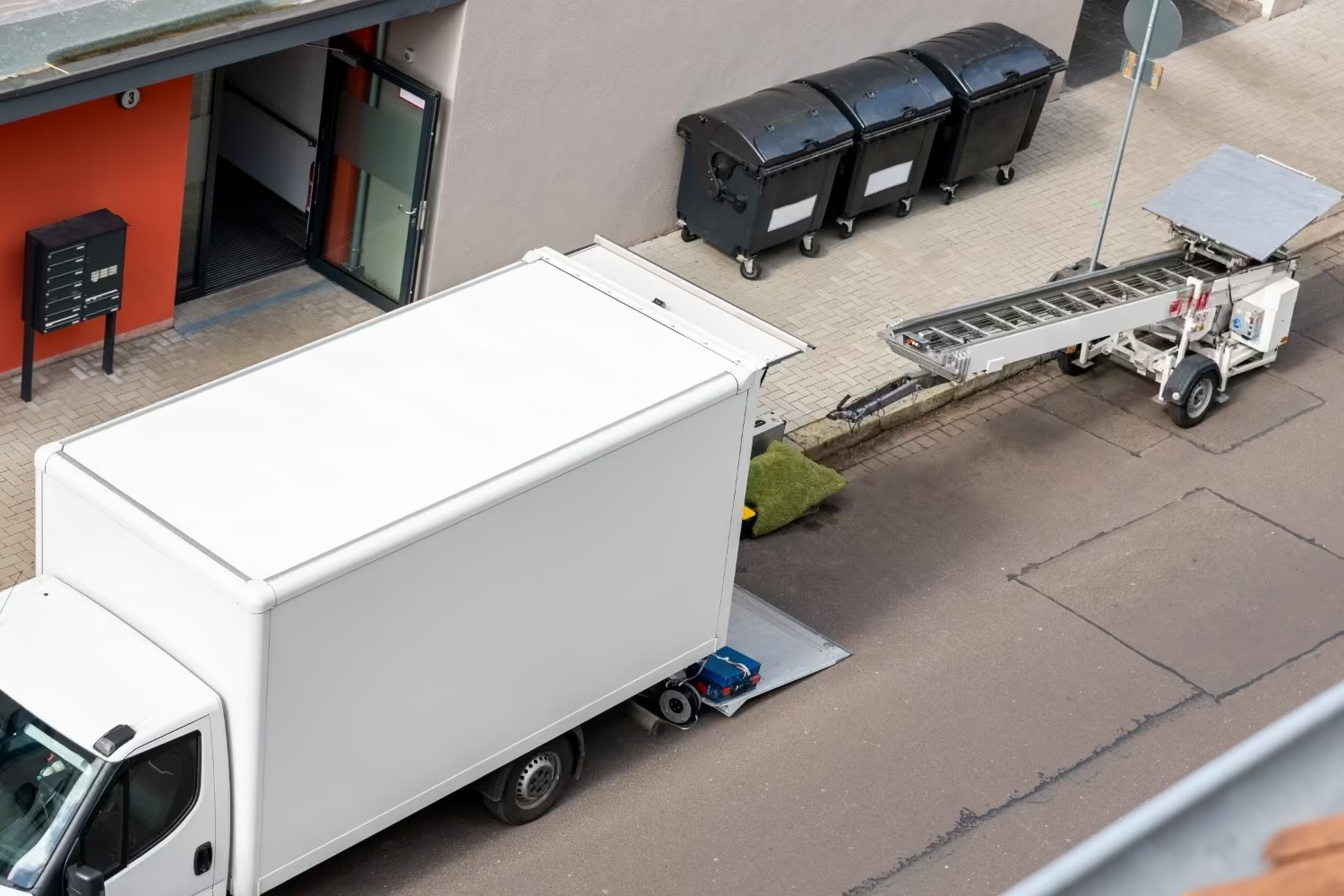
A perfect example is the liftgate, a platform on the back of the truck that lowers freight to the ground. If your pickup or delivery location doesn't have a raised loading dock, you will need one. The key to avoiding unexpected fees is to be upfront about these needs when you get an ltl quote, ensuring all necessary services are included from the start.
Is LTL a Good Fit For You? A Quick Checklist
Deciding if LTL is right for you is simple. It's likely your best option when:
- Your shipment is over 150 lbs.
- It can be secured safely on a pallet.
- Saving money is more important than a guaranteed delivery date.
Getting your first LTL quote is just as straightforward. Have three pieces of information ready: your shipment's exact weight and dimensions, the full pickup and delivery addresses, and any special services needed (like a liftgate). With this in hand, you're ready to put LTL freight to work with less than truckload efficiency.
Learn more: